

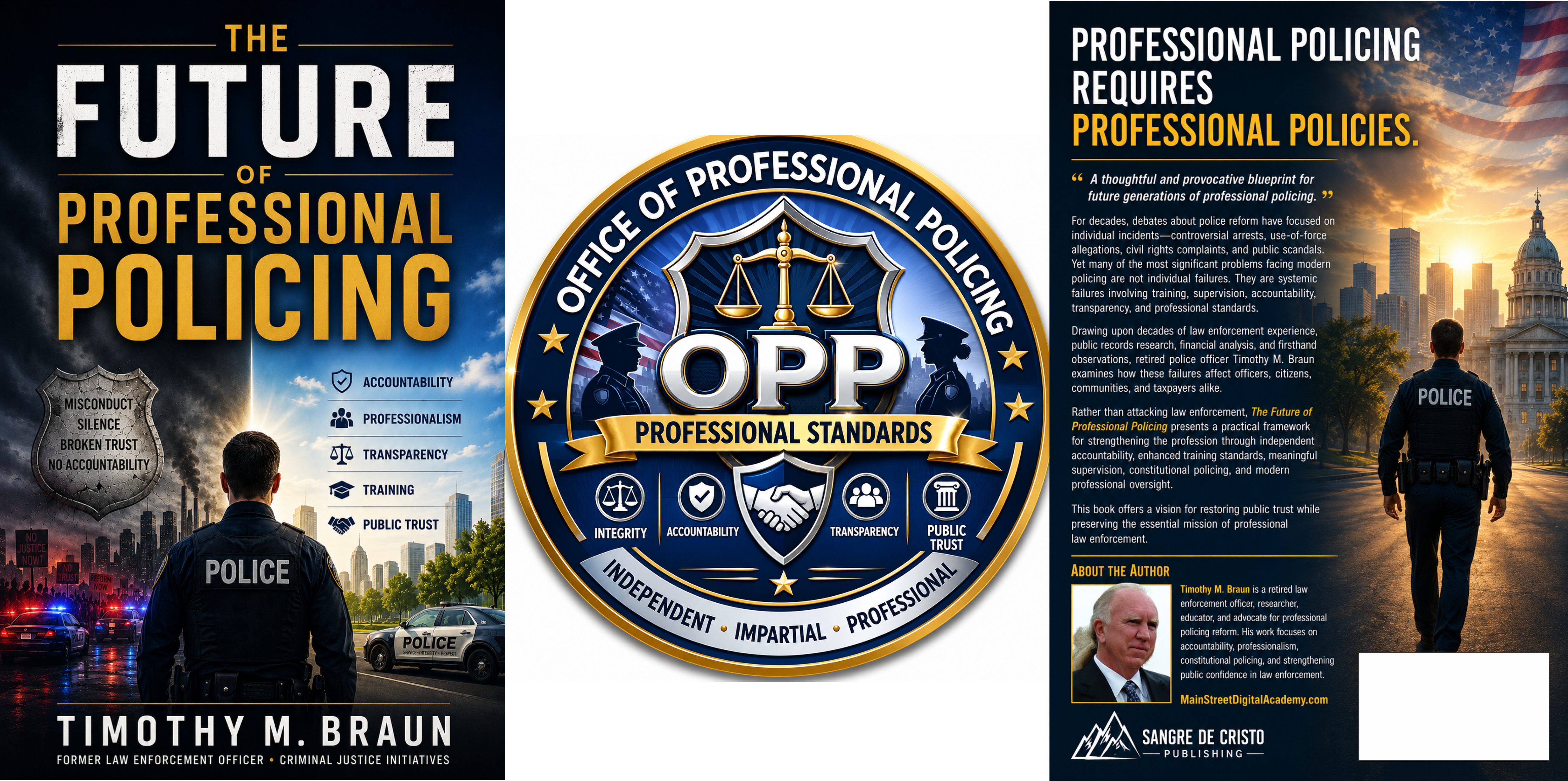
A Practical Insider’s Blueprint for Restoring Trust, Accountability, and Professionalism in Policing While Protecting Good Officers and Taxpayers.
A professional is more than a dictionary definition. Professionalism is about expertise, a sense of responsibility, advanced knowledge, attitude and conduct – a moral compass if you like – and one that is becoming ever more prominent and important today in modern policing.
Policing without a doubt is a profession. But can we say that police officers are true professionals in every sense of the word?
As a retired officer, I really want to say “Absolutely,” but I’m sorry, I have to say, “Not yet.”
Professional policing requires professional oversight.
"A thoughtful and provocative blueprint for future generations of professional policing."
For decades, debates about police reform have focused primarily on individual incidents—controversial arrests, excessive force allegations, civil rights complaints, and highly publicized scandals. Yet many of the most significant problems facing modern policing are not individual failures. They are systemic failures involving training, supervision, accountability, transparency, and professional standards.
Drawing upon decades of law enforcement experience, extensive public records research, financial analysis, and firsthand observations, retired police officer Timothy M. Braun examines the structural issues that contribute to misconduct, public distrust, escalating litigation costs, and declining confidence in the profession.
Rather than attacking law enforcement, The Future of Professional Policing offers a practical roadmap for strengthening the profession through independent accountability, improved training standards, meaningful supervision, constitutional policing, and modern professional oversight.
Inside the book, readers will explore:
• Why misconduct often develops gradually within organizations
• The hidden financial costs of police misconduct and litigation
• The limitations of traditional Internal Affairs investigations
• The impact of inadequate academy and field training
• Professional licensing concepts and independent oversight models
• False arrest compensation and citizen remedies
• Accountability systems that protect both citizens and ethical officers
• A comprehensive framework for the future of professional policing
This book challenges policymakers, law enforcement leaders, officers, and citizens to reconsider an important question:
If policing is truly a profession, it should it be held to the same standards of accountability expected of every other profession entrusted with public trust.
In the book, we recommend no more "Internal Affairs" to determine possible officer misconduct. This is usually tainted, whether by public perception or actual actions. Instead we suggest instituting an "Office of Professional Policing (OPP)" using retired officers, judges, lawyers, etc., personnel who are professionals in law enforcement to determine if misconduct is present or not and define any possible punishment if found. This is in line with all other "licensed professionals".
We recommend all law enforcement offices be required to have certified complaint forms and be able to send them directly to the OPP.
We go a step further and recommend that those who have been falsely arrested, or have been wrongly injured by an officer, be compensated quickly (within 2 months) by using professional negotiators instead of the victims having to hire lawyers, file a lawsuit, and wait 3-9 years for compensation. Plus having to pay their lawyers upwards of 50%+ of any award. This will also save taxpayers millions of dollars.
There are many sections of the book like these and I hope you will enjoy the book and understand what it is trying to do.
TO ORDER THE BOOK (click here): 
About the Author
Timothy M. Braun is a retired law enforcement officer, researcher, educator, and advocate for professional policing reform. Drawing upon firsthand experience within the criminal justice system, he examines how training, supervision, accountability, and institutional culture shape both officer performance and public trust.
His work focuses on practical reforms designed to strengthen constitutional policing, improve professional standards, reduce liability exposure, and restore confidence in law enforcement through professionalism, transparency, and accountability.
The author is available for guest lectures, conference presentations, workshops, panel discussions, law enforcement training programs, civic organizations, and media interviews. Scheduling, travel arrangements, and compensation, if applicable, may be discussed on an individual basis.
Contact Information:
For speaking engagements, training programs, workshops, consultations, media inquiries, or additional information regarding the Office of Professional Policing (OPP) framework:
Email: ProfessionalPolicing@gmail.com
I have launched a GO Fund Me page. I am seeking support to establish a nonprofit organization dedicated to advancing these principles through education, research, outreach, and development of practical accountability frameworks.
Funds will be used for nonprofit formation, legal and accounting services, website development, educational materials, and presentations. Establishing a nonprofit will also allow pursuit of future state, federal, foundation, and private grant opportunities.
Thank you for helping launch this initiative and support the future of professional policing.
Please go here to donate: Go Fund Me